
Updated . Originally published .
The pest control marketing ideas that work best are the ones that help local homeowners find you, trust you and come back. That means a complete Google Business Profile, a steady flow of recent reviews, seasonal campaigns timed to pest pressure, win-back offers for past customers, and a referral program. Paid search, short video and neighborhood social groups add reach on top of that foundation.
Competition is why this matters. IBISWorld estimates the US pest control industry at $29.7 billion in revenue in 2026, up from $29.2 billion in 2025, with 34,076 businesses competing for customers. Most of those companies chase the same homeowners in the same towns, so the companies that grow are usually the easiest to find and the easiest to trust, not the biggest spenders.
What homeowners do before they call
of consumers read reviews for local businesses.
BrightLocal Local Consumer Review Survey 2026
decide which local business to use in under 30 minutes.
BrightLocal Consumer Search Behavior Survey 2026
used AI tools for local business recommendations, up from 6% a year earlier.
BrightLocal Local Consumer Review Survey 2026
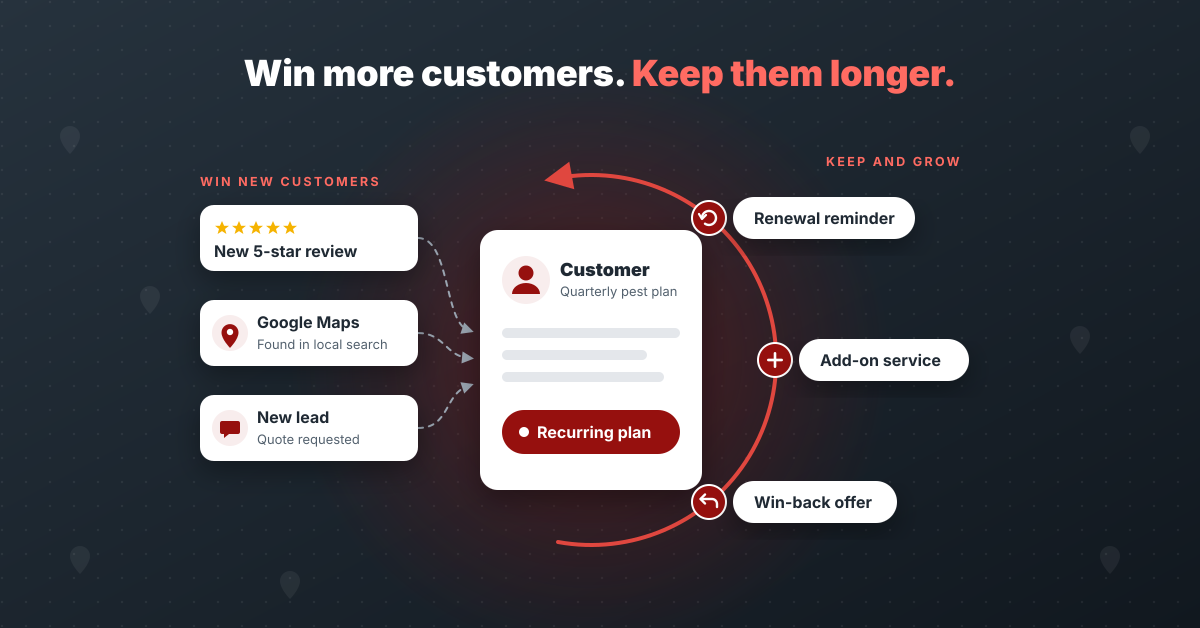
Below are 10 ideas you can put to work. Ideas 1, 2 and 5 through 10 help you win new customers. Ideas 3 and 4 help you keep and grow the customers you already have, which is where recurring revenue comes from. Some ideas cost only time. Others, like paid search, need a budget. Not sure where to begin? Jump to the 2-question picker. For a full plan, see our ultimate guide to pest control marketing.
1. Optimize Your Google Business Profile
Your Google Business Profile is often the first thing a homeowner sees when they search for pest control near them, and it decides whether you appear in the map results at all. Google says local results are based mainly on relevance, distance and prominence, and that review count and review score factor into local ranking. A complete, active profile supports all three.
- Choose the most specific primary category for your business, and add secondary categories only for services you actually offer, such as termite control.
- Set your service area to the towns your technicians actually route to.
- Keep your name, phone number, hours and website identical everywhere your business is listed.
- Add real photos of your trucks, uniformed technicians and completed work, and refresh them a few times a year.
- Post seasonal updates and offers so the profile shows recent activity.
- Answer common questions on your website and in your business description, so customers get answers before they call.

2. Build a Steady Stream of Reviews
Reviews are the trust signal homeowners check before they let a company into their home. BrightLocal’s Local Consumer Review Survey 2026 found that 97% of consumers read reviews for local businesses. The same survey found that consumers pay close attention to how recent reviews are, so the goal is a steady flow, not a one-time push.
- Ask right after a good visit, by text, while the technician’s work is fresh in the customer’s mind.
- Make it one tap. Send a direct link to your Google review form instead of asking customers to search for you.
- Reply to every review, good and bad. BrightLocal (2026) reports that 89% of consumers expect owners to respond, and 42% are unlikely to use a business that ignores its reviews.
- Look beyond Google. Facebook, Yelp, Nextdoor, Angi, the Better Business Bureau and Apple Maps all show up when homeowners research local companies.
- Never buy or script reviews. Ask every customer the same way, and let them say what they want.
Here’s a review request text you can copy and adapt:
Hi [First name], thanks for having [Company] out today. If [Technician] took good care of you, would you leave us a quick review? It takes about a minute: [review link]. If anything wasn’t right, just reply here and we’ll make it right.
Want appointment reminders and service notifications to go out without manual texting? Take a self-guided tour of Briostack.
For more ways to earn reviews, see our guide to generating more online reviews.
3. Run Seasonal Campaigns Matched to Pest Pressure
Homeowners buy pest control when they see pests, so the best campaigns land just before customers start noticing them. A simple calendar keeps your promotions ahead of each season instead of reacting to the phone.
Spring
Common pest pressure
Ants, termite swarms, wasps starting nests
Campaign ideas
- Termite inspection offers
- Ant program sign-ups
- New recurring plans timed to the first warm weeks
Summer
Common pest pressure
Mosquitoes, wasps and other stinging insects, ticks
Campaign ideas
- Mosquito add-ons for current customers
- Stinging insect removal
- Treatments before backyard events
Fall
Common pest pressure
Rodents moving indoors, overwintering pests such as stink bugs and spiders
Campaign ideas
- Rodent exclusion offers
- Fall perimeter treatments
- Renewal reminders
Winter (off-season)
Common pest pressure
Indoor rodents, slower inbound demand
Campaign ideas
- Annual prepay offers
- Home inspections
- Service bundles for next season
- Win-back campaigns
Timing varies by region. In warm southern climates, pest pressure runs most of the year; in northern states, seasons are shorter and sharper. Adjust the calendar to what your technicians see on their routes.
The off-season deserves its own plan. Winter is when you can lock in next year’s revenue with prepay offers, sell bundles before spring demand arrives, and reach past customers while your schedule has room. Promotions don’t have to mean discounts, either: a free add-on inspection or a bundled service often protects your margins better than a percentage off.
4. Win Back Past Customers and Grow Current Ones
Your easiest new revenue often comes from people who already know you: customers who canceled, one-time services that never became a plan, and current customers who don’t use every service you offer. A win-back or reactivation campaign gives them a clear reason to come back, and it often costs less than finding a brand-new customer.
- Reactivate lapsed customers. Pull a list of customers who canceled or haven’t had service in 12 months or more. Send a short email and text with a reason to return, such as a seasonal inspection or a returning-customer offer.
- Convert one-time jobs into plans. Offer a recurring plan right after a one-time service, while the problem is fresh.
- Offer the service they don’t have yet. Mosquito control for quarterly pest customers, or termite protection for homes without it.
- Send renewal reminders before agreements lapse, not after.
- Handle price increases on purpose. When costs rise, give customers notice and a clear reason instead of avoiding increases for years and absorbing the difference.
For campaign copy and timing, see our pest control email marketing guide.
5. Launch a Referral Program
Satisfied customers already recommend pest control companies to their neighbors. A referral program gives them a reason to do it on purpose, and referred customers arrive already trusting you.
- Keep the reward simple, such as a service credit for both the customer who referred and the new customer.
- Ask at happy moments: after a problem is solved, after a five-star review, or at renewal time.
- Make credit easy to claim with a code, a link, or a “Who referred you?” question when new customers book.
- Record the referral source on each new customer record, so you can thank referrers quickly and see which customers send the most business.
For a step-by-step program, see our guide to getting more pest control referrals.
6. Partner With Complementary Businesses
Other home service businesses are looking for ways to generate leads and add value for their customers too. Good partners include:
- HVAC companies
- Electricians
- Home cleaning companies
- Contractors and remodelers
- Real estate agents and property managers
- Home improvement companies
Three simple ways to set up a partnership:
- A referral swap: agree to recommend each other when a customer needs the other service.
- Co-marketing: share a seasonal mailer, a joint offer or a booth at a local home show.
- Real estate relationships: home sales often call for wood-destroying insect inspections, so become the company local agents call first.
Research every partner before you commit, because their reputation affects yours, and yours affects theirs. If your team works partner leads in one place, such as Briostack’s Sales App, follow-up is less likely to slip through the cracks.

7. Use Short Video to Show Your Expertise
Video lets homeowners see who will show up at their door before they book. According to Wyzowl’s State of Video Marketing 2026, 91% of businesses use video as a marketing tool, so customers are used to finding it. Four types work well for pest control:
- How-to videos that help homeowners handle minor issues. They build trust, so you’re the company people call for real problems. If your customers pay for a monthly or quarterly plan with recurring billing, they also cut down on small service calls.
- “When to call a pro” videos that walk through your technician’s process and the signs that need professional treatment.
- Brand videos that show your people and what makes your service different. See our pest control branding guide for help with the story.
- Live videos on Facebook, Instagram or YouTube, such as a live Q&A on seasonal pests. Always get permission before filming at a customer’s home.
Keep most videos under a minute for Instagram Reels, YouTube Shorts, TikTok and Facebook, and add your best ones to your Google Business Profile and service pages.
8. Show Up Where Neighbors Ask for Recommendations
Many pest control referrals now happen in local online communities, where neighbors ask, “Who do you use?” BrightLocal’s 2026 survey found Facebook is one of the most-used sources for local business recommendations, second only to Google.
- Facebook: keep your business page current, and take part in local Facebook Groups by answering pest questions helpfully, within each group’s rules.
- Nextdoor: claim your business page so neighbors can recommend and tag you.
- Instagram: owned by Meta, like Facebook, and a natural fit for visual posts: pest identification photos, damage examples and unusual finds from the field.
Be useful first and promotional second. A clear answer about carpenter ants does more for your reputation than another discount post.
Related: 4 Social Media Tips for Pest Control Companies and 22 Social Media Post Ideas for Pest Control Companies
9. Use Paid Search and Local Services Ads for Fast Leads
When a homeowner finds a mouse in the kitchen, they search and call quickly. Paid search puts you at the top of those results while your profile, reviews and content build over time. Speed matters: BrightLocal’s Consumer Search Behavior Survey 2026 found that 75% of consumers decide which local business to use in under 30 minutes, and 28% decide in under five.
- Local Services Ads often appear at the top of Google for searches like “pest control near me,” carry a Google Verified badge once you pass Google’s checks, and charge per lead rather than per click.
- Google Ads search campaigns let you target urgent, high-intent searches, such as wasp nest removal in your city, with call-focused ads.
- Schedule ads for when you can answer. A paid lead that reaches voicemail is usually a lost lead.
- Judge ads by cost per booked job, not cost per click.
For more paid and offline options, see our pest control advertising quick-start guide.
10. Make Your Business Easy for AI Assistants to Recommend
Homeowners increasingly ask ChatGPT or Google’s AI tools to recommend a local company. BrightLocal’s Local Consumer Review Survey 2026 found 45% of consumers used AI tools for local business recommendations, up from 6% a year earlier. AI doesn’t replace your Google presence, though: BrightLocal’s 2026 search behavior research found that most people who use AI to find a local business still check Google or Maps before contacting one.
No one can guarantee an AI recommendation, but the signals that help are the same ones that help your local search visibility:
- Consistent business information (name, address, phone, hours and services) on your website, Google Business Profile and directories.
- Plenty of recent reviews that naturally mention the services you provided and the towns you serve.
- A clear page for each main service on your website, with the areas you serve, what’s included and how to book.
- Plain-language answers to the questions customers ask most, such as how often treatments happen and whether they’re safe for pets.
How to Choose Where to Start
You don’t need all 10 ideas at once. Answer two quick questions for a starting point, or use the table below to match ideas to your budget and how quickly you need results.
Find your first three ideas
Two taps. No email.
1. Where is your business today?
2. How soon do you need results?
Choose an answer to both questions to see your starting three. Prefer to compare everything? The table below covers all 10 ideas.
| Idea | Upfront cost | Time to first results | Best for |
|---|---|---|---|
| Google Business Profile | Low (time) | Weeks | Every company; start here |
| Reviews | Low (time) | Weeks, then compounding | Every company |
| Seasonal campaigns | Low to medium | Within a season | Companies with an existing customer list |
| Win-back and upsell | Low | Weeks | Companies with past and current customers |
| Referral program | Low (reward cost) | Months | Companies with satisfied recurring customers |
| Partnerships | Low (time) | Months | Owners with strong local networks |
| Short video | Low to medium | Months | Owners and techs comfortable on camera |
| Neighborhood social | Low (time) | Weeks to months | Companies in active local communities |
| Paid search and LSAs | Medium to high | Days | Companies that need leads now and can answer fast |
| AI visibility | Low (time) | Months | Every company; overlaps with profile and review work |
If you're a newer company, start with your Google Business Profile, reviews and, if you need leads quickly, Local Services Ads. If you already have a customer base, start with seasonal and win-back campaigns, because the list you need is already in your software.
Measure What Works
Marketing only improves when you know which ideas produce customers. Keep the tracking simple:
- Ask every new caller how they heard about you, and record the answer on their customer record.
- Answer calls fast. With so many homeowners deciding within minutes, missed calls quietly erase the leads your marketing paid for. Our guide to reducing missed calls covers practical fixes.
- Count booked jobs and recurring sign-ups per campaign, not just leads or clicks.
- Review results monthly and move time and budget toward the ideas that produce recurring customers.
Pest Control Marketing Ideas FAQs
How do pest control companies get more customers?
Pest control companies get more customers by combining local visibility with retention. A complete Google Business Profile, steady reviews and Local Services Ads help new homeowners find and trust you, while seasonal offers, win-back campaigns and referrals bring back past customers and grow current ones.
What is the cheapest pest control marketing idea to start with?
Optimizing your Google Business Profile and asking every satisfied customer for a review are the cheapest places to start. Both cost mostly time, and both improve how often you appear in local map results.
How do you generate pest control leads in the off-season?
In the off-season, pest control companies can offer annual prepay plans, home inspections and service bundles for the coming season, run win-back campaigns to past customers, and build referral relationships with real estate agents and other home service businesses.
What should a new pest control company do first?
A new pest control company should set up a complete Google Business Profile, make sure its business information matches everywhere it's listed, ask early customers for reviews, and build a simple website with a page for each main service. If it needs leads quickly, Local Services Ads are a fast next step.
Run Seasonal and Win-Back Campaigns From Your Customer List
Most of these ideas cost time more than money. The ones that build recurring revenue, like seasonal offers, win-back campaigns and renewals, are easier to run consistently from the customer data you already have. Briostack's marketing tools, including the Marketing Playbooks add-on, help pest control companies turn service history into campaigns.
Not ready for a demo? Tour Briostack on your own. No email required.
Want the full strategy behind these ideas? Read our ultimate guide to pest control marketing.