15 Pest Control Promotional Ideas to Book More Jobs
Looking for pest control promotional ideas that actually work? Learn how seasonal packages, referral...
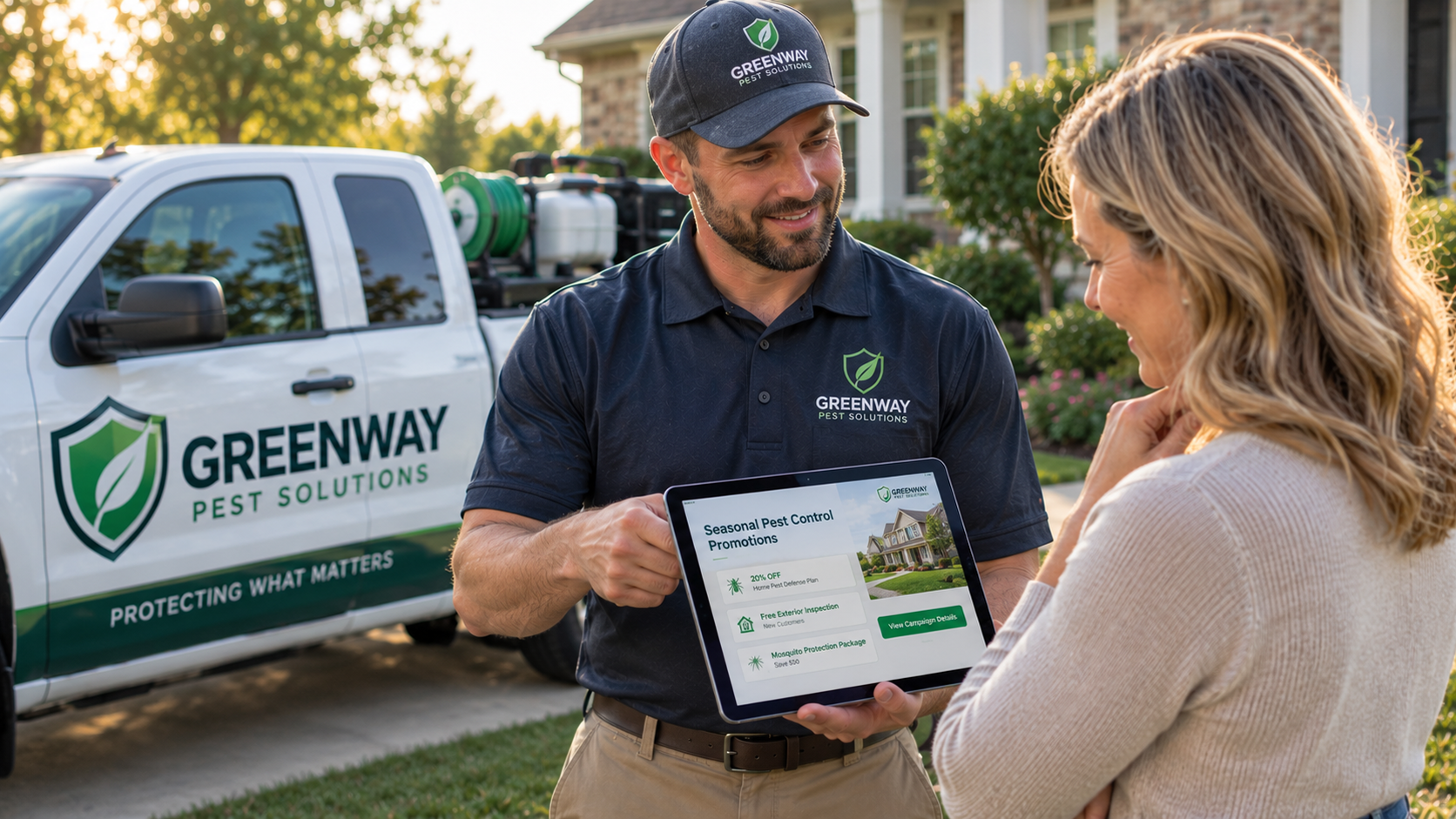
Running a successful pest control business takes more than great service. You also need a steady stream of new customers, enough work to keep technicians busy, and recurring service plans that generate reliable revenue throughout the year.
That’s where the right promotion can make a difference.
The best pest control promotions aren’t just discounts. They’re timely offers that solve a specific customer problem, create a reason to book now, and support your business goals—whether that’s attracting first-time customers, filling open appointment slots, or converting one-time treatments into recurring service plans.
In this guide, you’ll learn 15 practical pest control promotional ideas, when to use each one, and how to turn seasonal marketing into more booked jobs throughout the year.
The most successful pest control promotions have five things in common:
Whether you’re offering a free inspection, a referral reward, or a seasonal mosquito package, these five elements give customers a reason to book while helping you measure which promotions actually grow your business.
The best pest control promotions combine the right offer with the right timing. Seasonal campaigns, first-service incentives, referral programs, recurring service promotions, and customer loyalty campaigns can all generate more bookings when they’re easy to understand, create urgency, and solve a real customer problem. Instead of running random discounts throughout the year, build a promotion calendar that supports your business goals and measure the results so you can repeat what works.
A promotion shouldn’t exist just because business is slow.
Every campaign should support a specific objective. Sometimes that’s generating more leads. Other times it’s filling technicians’ schedules during slower weeks, increasing average ticket size, or encouraging customers to enroll in recurring service plans.
Before launching any promotion, ask yourself one question:
What business problem am I trying to solve?
Once you know the answer, build your promotion around these five principles.
| Element | Why It Matters |
| Clear offer | Customers should understand the value within a few seconds. |
| Urgency | A deadline or limited availability encourages customers to act now instead of waiting. |
| Seasonal timing | Promotions perform better when they match the pest problems customers are already experiencing. |
| Easy redemption | Whether customers call, book online, or redeem a promo code, the process should be simple. |
| Measurable results | Track bookings, recurring service conversions, and revenue so you know which promotions are worth repeating. |
Notice that none of these require offering the biggest discount.
In many cases, convenience, prevention, or bundled value outperform aggressive price reductions. A free termite inspection before spring, for example, often generates more qualified leads than a generic “20% Off” coupon because it aligns with what homeowners are already worried about.
Once you’ve built a strong offer, the next step is matching it to the right time of year.
One of the easiest ways to improve your marketing results is to align promotions with predictable pest activity.
Customers are much more likely to book when your promotion solves a problem they’re already experiencing. Rather than running the same offer year-round, build seasonal campaigns around the pests that become active during each part of the year.
Spring is one of the busiest seasons for pest control companies. As temperatures rise, termites begin swarming and ant activity increases, making preventative services especially appealing to homeowners.
A spring promotion should focus on helping customers identify problems early before they become expensive repairs.
Many homeowners don’t know they have termite activity until significant damage has already occurred. Offering a free or discounted inspection lowers the barrier to contacting your company and creates an opportunity to recommend treatment or ongoing protection.
Spring Termite Inspection Special
Protect your home before termite season reaches its peak. Schedule a spring inspection before April 30 and receive a complimentary home assessment.
Summer brings backyard gatherings, vacations, and increased outdoor activity. Unfortunately, it also brings mosquitoes, ticks, and fleas.
Rather than promoting a single treatment, position your offer around helping families enjoy their outdoor spaces throughout the season.
Customers don’t simply want mosquitoes eliminated. They want to enjoy cookouts, children’s play areas, and evenings outside without constantly fighting biting insects.
That emotional benefit often resonates more than talking about pesticides or treatment methods.
Summer Backyard Protection Package
Enjoy your outdoor spaces all season long with recurring mosquito treatments designed to keep biting pests under control.
As temperatures begin to drop, rodents start looking for warm places to spend the winter.
Fall promotions should focus on prevention before mice and rats move indoors.
Many homeowners don’t think about rodents until they hear scratching in the attic. Promoting exclusion services before winter helps customers avoid infestations instead of reacting to them later.
Fall Rodent Prevention Special
Keep mice outside where they belong. Schedule a home inspection this month and save on rodent exclusion services before winter arrives.
While insect activity slows in many regions, winter creates opportunities for indoor pest services.
Mice, cockroaches, spiders, and overwintering insects often become the primary concern.
Winter is also an excellent time to encourage preventative services before spring demand returns.
Unlike summer promotions, winter campaigns should focus less on urgency and more on prevention, convenience, and preparing homes for the busy pest season ahead.
Winter Indoor Protection Special
Keep unwanted pests from settling in this winter. Schedule an indoor pest inspection or enroll in an annual protection plan this month and enjoy added peace of mind before spring pest activity returns.
Related Reading: Marketing 101 for Pest Control Companies
The hardest customer to win is the one who’s never worked with you before.
New customers don’t know your technicians, your service quality, or your reputation. They’re comparing several companies at once and looking for a reason to choose yours.
The goal of a first-time offer isn’t to become the cheapest option. It’s to reduce the hesitation that comes with trying a new service provider.
Many homeowners aren’t sure whether they have a pest problem or how serious it is.
A free inspection removes much of the uncertainty and gives your technician an opportunity to identify the issue, explain the treatment plan, and recommend ongoing prevention if it’s appropriate.
Customers often delay calling because they don’t know what to expect. Offering an inspection instead of immediately selling a treatment makes the conversation feel educational rather than transactional.
Free Pest Inspection
Think you might have a pest problem? Schedule a free inspection and receive a customized treatment recommendation with no obligation.
A modest discount can help homeowners choose your company when they’re comparing multiple estimates.
The emphasis should always be on trying your service—not on becoming the lowest-priced provider.
The first appointment carries the most risk for customers. A limited introductory offer reduces that perceived risk while allowing you to demonstrate your service quality.
Once you’ve earned the customer’s trust, shift the conversation toward preventative care and recurring service rather than additional discounts.
Moving into a new home often means finding new service providers.
That makes recent homeowners one of the highest-value audiences for pest control marketing.
Many homeowners want to establish preventative pest protection before problems begin. A welcome offer positions your business as part of helping them settle into their new home.
Welcome to the Neighborhood
Celebrate your new home with a special offer on your first pest control service and start protecting your property from day one.
Satisfied customers are one of your best marketing assets.
When someone recommends your company to a friend or neighbor, you’ve already earned a level of trust that’s difficult to create through advertising alone.
Referral promotions simply encourage more of those conversations to happen.
Reward existing customers when someone they recommend becomes a new customer.
The reward doesn’t have to be expensive. In many cases, a service credit creates enough motivation to encourage referrals while keeping acquisition costs low.
People naturally recommend businesses they’ve had a positive experience with. A referral reward simply gives them an additional reason to mention your company.
Keep the process simple. Customers should immediately understand how they qualify and how they’ll receive their reward.
Online reviews influence almost every homeowner before they contact a local service business.
A consistent review campaign builds trust while improving your visibility in local search results.
Fresh reviews reassure potential customers that your business is active, responsive, and consistently delivering quality service.
Send a review request shortly after completing a successful service while the experience is still fresh.
Include a direct link to your preferred review platform so customers can leave feedback with as few clicks as possible.
Editorial note: Encourage honest reviews rather than rewarding only positive ones. This helps maintain credibility and aligns with the policies of many review platforms.
Pest problems rarely affect just one home.
If you’ve completed a termite treatment or rodent exclusion in one neighborhood, nearby homeowners may be dealing with the same issue.
People often notice pest activity—or contractor vehicles—in their neighborhood. That creates a natural opportunity to promote your services locally.
For example, after completing several mosquito treatments in one subdivision, you might send nearby homeowners a neighborhood-specific offer promoting outdoor protection.
This type of campaign feels more relevant than a generic advertisement because it reflects what’s happening locally.
Related Reading: 10 Tips for Marketing for Pest Control Companies
Some promotions generate one appointment.
Others generate customers who stay with your company for years.
Whenever possible, design promotions that naturally transition customers into recurring service plans. That creates more predictable revenue, steadier technician schedules, and stronger customer retention over time.
Many customers know they’ll eventually need pest control again.
Offering a small incentive for enrolling in an annual plan encourages them to make that decision now instead of waiting until the next infestation.
Customers appreciate predictable pricing and year-round protection, while your business benefits from recurring revenue and more consistent scheduling.
Rather than emphasizing the discount itself, focus on the value of ongoing prevention.
Bundling complementary services increases perceived value while raising the average job size.
Examples include:
| Bundle | Best Time to Promote |
| Mosquito + Tick Protection | Spring and Summer |
| Rodent Exclusion + Home Inspection | Fall |
| General Pest Control + Termite Inspection | Spring |
| Quarterly Pest Service + Mosquito Program | Summer |
Customers appreciate solving multiple pest problems with one appointment, and bundled services often generate more revenue than individual treatments.
Prepayment incentives encourage customers to commit to recurring service while improving your cash flow.
Instead of collecting payments throughout the year, your business secures revenue upfront while customers receive a modest discount for paying in advance.
This approach works particularly well for annual pest protection programs and seasonal mosquito services.
Winning a new customer is important.
Keeping existing customers is often even more valuable.
Loyalty promotions reward customers for staying with your business, while win-back campaigns help reconnect with customers who haven’t scheduled service in a while.
Show appreciation to long-term customers with occasional exclusive offers.
Examples include:
Small gestures reinforce customer relationships and remind people why they’ve stayed with your company.
Not every inactive customer is gone for good.
Some simply haven’t needed service recently—or forgot to schedule their next treatment.
A friendly reminder paired with a limited-time offer can often restart the relationship.
We’ve Missed You
It’s been a while since your last service. Schedule your next appointment before the end of the month and receive a complimentary inspection.
Keep these campaigns helpful rather than overly sales-focused. The goal is to remind customers of the value you provide, not pressure them into booking.
The best marketing doesn’t always happen online.
Getting involved in your community keeps your business visible long before homeowners discover ants in the kitchen or hear mice in the attic. These promotions build familiarity and trust, making your company the first one people think of when they need pest control.
Look for businesses that serve the same homeowners you do without competing for the same work.
Good partners include:
For example, a real estate agent could include a voucher for a discounted pest inspection in every new homeowner welcome packet, while you recommend that agent to customers preparing to buy or sell a home.
These partnerships generate referrals that feel more personal than traditional advertising.
Community sponsorships help build brand recognition while demonstrating that you’re invested in the neighborhoods you serve.
Consider sponsoring:
These promotions aren’t designed to produce immediate bookings.
Instead, they increase familiarity so homeowners remember your business when pest problems eventually arise.
A great promotion won’t generate results if nobody sees it.
Instead of relying on a single marketing channel, promote your offers wherever customers already interact with your business.
| Marketing Channel | Best For |
| Existing customers, seasonal reminders, annual plan promotions | |
| SMS | Limited-time offers, appointment reminders, open schedule availability |
| Facebook & Instagram | Seasonal awareness campaigns and local promotions |
| Google Ads | Capturing homeowners actively searching for pest control |
| Direct Mail | New homeowners and targeted neighborhoods |
| Website | Year-round promotional landing pages |
The goal isn’t to use every channel.
It’s to consistently use the channels your customers already pay attention to.
For example, an email announcing your annual mosquito package can be reinforced with Facebook ads targeting homeowners in the same service area and a text reminder to customers who haven’t renewed yet.
Multiple touchpoints often outperform a single advertisement.
Not every customer should receive the same offer.
A homeowner who signed up for quarterly service last month doesn’t need the same promotion as someone who hasn’t scheduled service in two years.
Whenever possible, segment your audience by:
More relevant promotions generally produce better response rates while reducing unnecessary marketing.
Managing these campaigns becomes much easier when your customer records, service history, and communications are all in one place. Briostack helps pest control companies segment customer lists, automate email and text campaigns, and track which promotions generate booked work and recurring revenue.
Running promotions doesn’t have to be complicated. However, a few common mistakes can reduce results and cut into profitability.
Avoid these pitfalls whenever possible.
If every month features a different discount, customers quickly learn to wait for the next sale.
Instead, focus on a handful of well-planned campaigns tied to seasonal demand and business goals.
Discounts may increase bookings, but they can also reduce profit margins and attract customers who are unlikely to stay long-term.
Whenever possible, compete on value instead.
Free inspections, bundled services, recurring plans, and preventative care often create stronger long-term relationships than deep discounts.
Customer priorities change throughout the year.
A mosquito promotion performs far better in June than in December.
Matching your offers to seasonal pest activity keeps your marketing relevant.
Without measurement, every promotion feels successful—or unsuccessful—based on opinion.
Track the numbers so you know which campaigns deserve another investment.
The most successful companies don’t create promotions only when business slows down.
Instead, they plan campaigns months in advance so marketing supports predictable seasonal demand.
| Season | Customer Concern | Recommended Promotion | Primary Business Goal |
| Winter | Indoor pests, renewing service | Annual plan discounts, loyalty rewards, indoor inspections | Improve retention and generate off-season work |
| Spring | Termites, ants, preventive treatments | Free inspections, first-service offers, termite promotions | Acquire new customers before peak season |
| Summer | Mosquitoes, ticks, fleas | Outdoor protection packages, service bundles, referral campaigns | Increase average ticket size and maximize seasonal demand |
| Fall | Rodents moving indoors | Rodent exclusion packages, win-back campaigns | Fill schedules and grow recurring service |
Planning your promotions around pest seasonality also makes scheduling easier for your office staff and technicians.
Rather than scrambling to launch campaigns after business slows, you’ll already have promotions prepared before demand shifts.
Launching a promotion is only half the job.
The real value comes from understanding which campaigns generate profitable customers—and which simply create activity.
Use this simple framework every time you launch a new promotion.
Choose one objective.
Examples include:
Trying to accomplish everything with one promotion usually weakens the message.
Send the promotion only to customers who are likely to benefit.
A first-service discount belongs in front of new prospects.
A loyalty reward belongs in front of long-term customers.
Segmentation almost always produces better results than sending the same promotion to your entire database.
Customers rarely respond after seeing a promotion just once.
Reinforce your campaign across several channels, such as:
Consistency improves recall and increases the chances that customers take action.
Every promotion should have measurable outcomes.
Monitor metrics like:
| Metric | Why It Matters |
| Booked jobs | Shows whether the promotion generated demand |
| Revenue | Measures total financial impact |
| Average ticket size | Indicates whether customers purchased additional services |
| Recurring plan conversions | Shows long-term value beyond the initial booking |
| Customer acquisition cost | Helps evaluate profitability |
| Return on investment (ROI) | Determines whether the promotion should be repeated |
Looking beyond bookings gives you a much better understanding of which campaigns actually grow your business.
Every promotion teaches you something.
Review what worked, what didn’t, and how customers responded before launching the next campaign.
Over time, you’ll build a repeatable marketing system that fills your schedule without relying on constant discounts.
The best pest control promotions don’t rely on deep discounts or flashy advertising. They solve a timely customer problem, make it easy to book, and support a specific business goal.
Some campaigns are designed to attract new customers. Others help increase average ticket size, convert one-time treatments into recurring service plans, or keep technicians productive during slower months. The key is choosing promotions that fit where your business is today rather than trying to run every idea at once.
If you’re ready to improve your marketing, start with these four steps:
Over time, those small improvements become a repeatable marketing system that helps keep your schedule full while building more predictable recurring revenue.
If you’re managing customer lists, seasonal promotions, and follow-up campaigns manually, software can simplify the process. Briostack helps pest control companies automate customer communications, segment audiences, and measure campaign performance so you can spend less time managing promotions and more time growing your business.
The best promotion depends on your business goal. Free inspections and first-service offers are effective for attracting new customers, while referral rewards, annual service discounts, and seasonal packages are better for increasing recurring revenue and customer retention.
Most companies benefit from planning four major seasonal promotions each year, supported by smaller campaigns for referrals, renewals, loyalty rewards, and customer win-back efforts. Building promotions around seasonal pest activity keeps your marketing relevant throughout the year.
No.
Discounts can increase response rates, but they aren’t the only way to create value. Free inspections, bundled services, annual protection plans, and priority scheduling often perform just as well while protecting your profit margins.
Winter inspection specials, annual service discounts, loyalty rewards, and customer win-back campaigns are excellent ways to generate work during slower months while strengthening long-term customer relationships.
Use several marketing channels together. Email, SMS, social media, Google Ads, your website, and direct mail all work better when they reinforce the same message instead of operating independently.
Don’t measure success by bookings alone.
Track:
These metrics provide a much clearer picture of which promotions contribute to long-term business growth.
Looking for pest control promotional ideas that actually work? Learn how seasonal packages, referral...
Learn how to build a pest control referral program that consistently generates new business....

Discover how to use social media to grow your pest control business. Learn practical...