The Hidden Costs of Operational Tax in Pest Control (and How to Spot Them)
Operational tax is the hidden cost of unnecessary work that builds as your pest...
The pest control industry is growing. Total service revenue reached $13.4 billion in 2025, up from $12.6 billion the year before.
That’s great news for pest control business owners. But growth comes with a challenge that isn’t always obvious.
As you add customers, technicians, and routes, the work required to keep everything running grows too. Many owners assume that’s simply the cost of running a larger business.
Often, it isn’t.
It’s actually operational tax—the hidden cost of unnecessary work that builds as your business grows.
Unlike a one-time inefficiency, operational tax compounds over time. Extra administrative work, manual handoffs, and disconnected processes chip away at technician productivity, office capacity, cash flow, and profit margins.
But the good news is, operational tax doesn’t have to be a given, even as you scale.
In this guide, you’ll learn how to recognize the warning signs of operational tax. We’ll also review how to understand what’s causing it and identify opportunities to reduce it before it limits your growth.
Let’s jump in.
Operational tax is the hidden cost of avoidable work your team does every day just to keep services running. It includes duplicated tasks, manual handoffs, and extra steps that add no value to the customer or revenue to your business.
This extra work burdens office staff, frustrates technicians, delays revenue collection, and makes it harder to grow without adding headcount.
Here’s a simple example of what it looks like in practice.
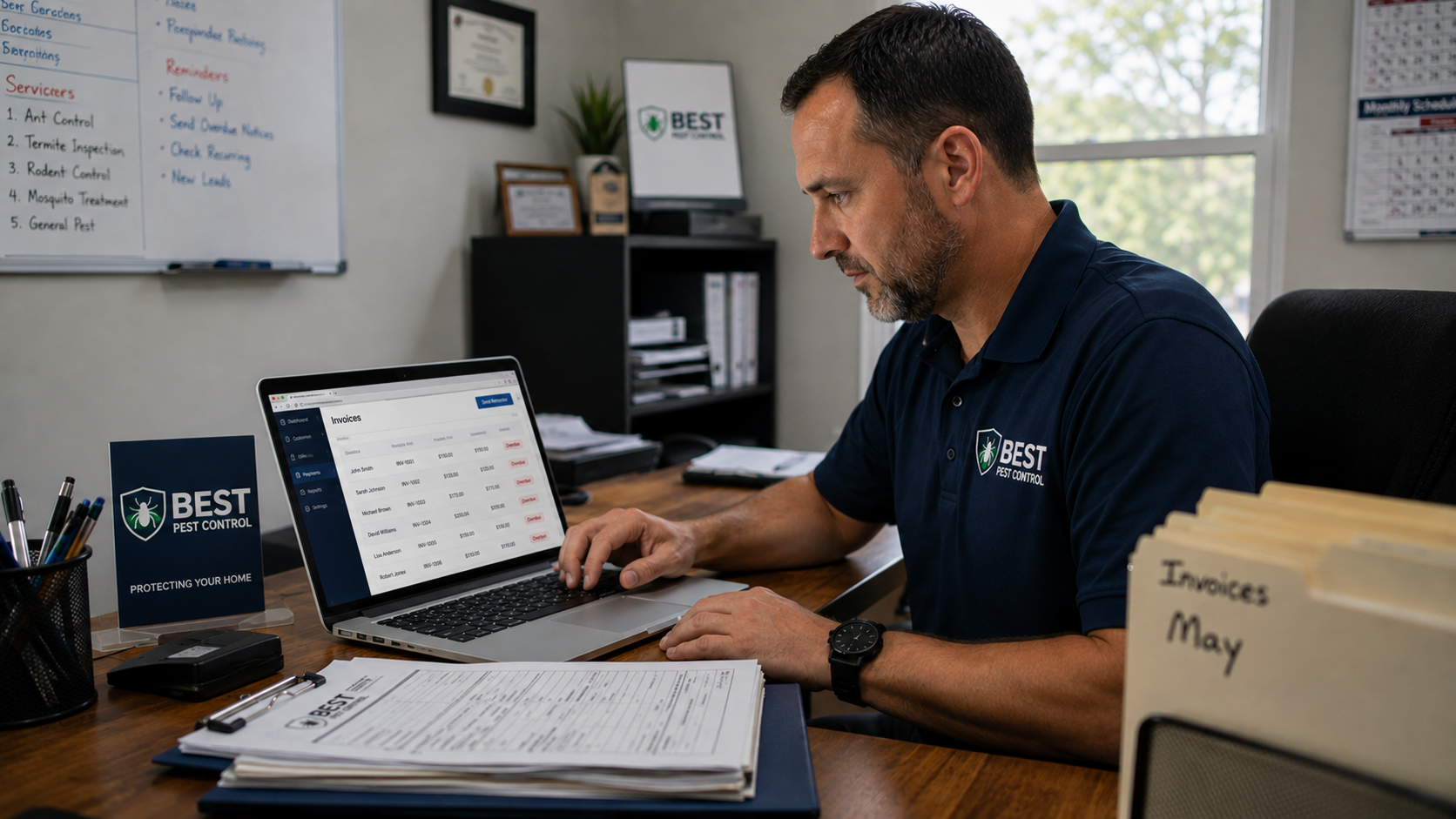
One of your technicians finishes a job and calls the office with a service update. Then someone writes it down. Someone else updates the schedule. Another employee follows up with the customer.
None of those tasks are the problem on their own. The operational tax comes from passing information between people and entering it manually over and over again.
Now multiply that process across every technician, every job, every day.
That accumulation is especially important to consider in pest control, where recurring service drives the business. The average pest control company earns 74% of its revenue from recurring customers, meaning the same inefficiencies repeat on every scheduled visit.
Operational tax isn’t a one-time expense. It’s a cost you pay again and again.
Take one common task for example: technicians calling the office with a service update after every job. The actual cost is easier to understand when you look at how small tasks compound over time.
Task time × number of employees × daily frequency × working days = annual labor cost
Here’s what that might look like:
Over 250 working days, those updates consume more than 1,600 hours of technician time each year.
10 minutes × 5 technicians × 8 jobs × 250 days = about 1,667 hours
At $20 per hour, that’s more than $33,000 in technician labor alone. And that doesn’t include the office employee’s time to receive, record, and process every update.
RELATED ARTICLE: How to Improve Your Customer Service in Pest Control
Operational tax is easy to miss because it rarely shows up as a single problem. Instead, it hides in the small tasks and extra steps your team repeats every day.
Here are seven signs it may be costing your business more than you realize.
| Sign | What it looks like | The hidden cost |
| Office always busy | Staff can’t explain where the day went | Labor hours absorbed by low-value admin |
| Jobs are finished but work isn’t | Technicians finish the job, but office staff still have to process the work manually | Lost technician productivity and office time |
| Admin tasks consume hours | Scheduling, invoicing, and follow-ups done manually | Hours per week that don’t generate revenue |
| New customers create more work | Onboarding a new account takes multiple steps | Office capacity erodes as the customer base grows |
| Team relies on workarounds | Spreadsheets, sticky notes, and text threads | Errors, missed follow-ups, and information loss |
| Revenue is delayed | Invoices go out days after service is completed | Cash flow pressure and outstanding balances |
| Hiring feels like the only option | Growth requires adding head count to cope | Higher labor costs |
Now, let’s look at each warning sign in more detail.
Your office staff is constantly busy. But when you ask what filled their day, the answer is usually a long list of small tasks like:
Each task feels quick and necessary in the moment. Together, though, they consume hours without directly moving the business forward.
And according to Forbes, these kinds of low-value activities can take up more than one-third of a business owner’s time.
The business impact: Your office team’s capacity gets absorbed by administrative work, leaving less time for activities that support growth.
RELATED ARTICLE: How Growing Pest Control Companies Reduce Manual Work with Automation
When a technician finishes a treatment, it should mark the end of the job. Instead, it often triggers another round of work back at the office.
For example, someone still needs to log the service, update the customer record, and schedule the next visit.
Multiply that across five technicians completing eight jobs each day, and your office is processing 40 completed services on top of everything else it already handles.
The business impact: As service volume grows, administrative work grows with it, putting more pressure on your office staff.
Good pest control office management requires a lot of tasks that seem quick in isolation. Things like updating customer information, sending a reminder, or documenting a service call don’t seem significant on their own.
The problem is volume.
Using the same cost-compounding formula:
That’s about 417 hours annually—or more than 10 full working weeks spent on small administrative tasks.
The business impact: Time disappears into repetitive work, leaving less capacity for higher-value activities.
Adding a new recurring customer should be a win. But for many pest control companies, every new account also creates more administrative work.
That often includes:
When you had 20 customers, those extra steps were manageable. At 100 or 200, they become an operational problem.
Growth should increase revenue, not create a growing administrative burden.
The business impact: As your customer base grows, office capacity shrinks unless your processes become more efficient.
Every pest control business develops its own way of getting work done—their own pest control workflows.
For growing companies, though, those workflows often rely on spreadsheets, sticky notes, text threads, or a collection of disconnected tools that evolved over time.
Those workarounds may do the job for a while. But as your business grows, they become harder to manage.
They also come with other hidden operational costs. That includes issues like having processes only one employee understands, being unable to scale as your customer base grows, and creating information gaps that lead to missed service or customer frustration.
The business impact: Your operation depends on individual memory instead of consistent, reliable processes.
If a technician finishes a job on Monday, how long does it take for your business to actually see that revenue?
With a manual billing process, payment often starts much later:
That’s a long gap between completing the work and collecting the revenue.
On average, businesses have more than $17,000 in unpaid invoices. That’s a lot of your revenue to leave sitting unpaid.
The business impact: The longer invoicing takes, the longer your business funds completed work out of its own pocket.
RELATED ARTICLE: 2025 Pest Control Industry Statistics & Growth Insights
When the workload becomes overwhelming, the first instinct is often to hire another employee. Sometimes that’s the right move.
But if inefficient workflows are creating most of the extra work, adding headcount simply increases payroll without fixing the underlying problem.
Then, you’re paying more people to work around the same inefficiencies.
The business impact: Labor costs rise while margins continue to shrink.
Operational tax doesn’t stay the same size as your business grows. It compounds.
When you had two technicians and 50 recurring accounts, the extra administrative work was manageable. Now you have five technicians, 200 accounts, and three routes to coordinate.
The tasks haven’t changed. There are just more of them.
Every manual process, duplicated step, and unnecessary handoff happens more often as your customer base grows. Without more efficient workflows, the workload increases faster than your team’s capacity.
That’s why operational tax becomes more expensive over time.
Here’s what that means for your business:
RELATED ARTICLE: How to Build a Pest Control Scheduling System That Works
By now, you’ve probably identified a few places where operational tax is slowing your business down.
The next step is figuring out where that extra work comes from.
Some operational tax comes from manual processes. Some comes from disconnected workflows, outdated procedures, or inconsistent training. And sometimes, it’s the result of software that no longer supports the way your business operates.
The key is to look for the source of the friction, not just the symptoms.
Ask yourself questions like:
If you’re answering “yes” to several of those questions, your pest control software may be contributing to operational tax.
In some cases, this can be a result of your business outgrowing the way your current platform supports your workflows. The right platform should be reducing your workload, not adding more to it.
The important thing before you make any decisions, though, is understanding where the extra work originates.
If you’re wondering whether your current software is helping reduce operational tax or actually adding to it, our guide—The Hidden Operational Tax of Pest Control Software: Is Your Software Helping Your Business Grow or Slowing It Down?—walks through the questions to ask before making that decision.
Download the Guide ADD LINK HERE
Have questions about operational tax in a pest control business? Here are answers to a few common ones.
Operational tax is the hidden cost of unnecessary work that builds as your pest...
Learn how to build a pest control referral program that consistently generates new business....
Put your business goals into action with our free pest control action plan template....